
PORCH COLUMN REPAIR GUIDE
Repairing Rotten Porch Columns
A porch column or post is a vertical member that may support the porch roof or serve as decorative trim around a support. Localized exterior deterioration may be repairable when suitable wood remains, the moisture source is corrected, and repair suitability has been established. Movement, internal deterioration, uncertain connections, or possible load-bearing damage need qualified evaluation before wood is removed or repair materials are chosen.
THE SHORT ANSWER
Can a Rotten Porch Column Be Repaired?
A localized exterior area may be repairable when the moisture source can be corrected, deteriorated material can be removed, suitable wood remains, and support and hidden-condition questions have been resolved. Replacement or qualified evaluation is more appropriate when the support function, interior condition, movement, or adjoining framing is uncertain.
A Localized Repair May Fit
The affected area is limited to an exterior base, trim, or profile; the surrounding condition is understood; and the project has been determined to be appropriate for a localized repair.
Evaluate the Column First
The column may support a roof or beam, movement is visible, the core is hollow or inaccessible, deterioration continues inside, or adjoining framing may be affected.
Repair materials do not establish structural suitability
WRP can help plan products for an appropriate localized repair. A qualified contractor, engineer, or other appropriate professional may be needed to evaluate loads, temporary support, hidden conditions, or adjoining framing.
LOAD-BEARING AND REPAIRABILITY GATE
Resolve Support and Hidden-Condition Questions First
Do not assume a porch column is decorative. Before disturbing the base or trim, determine what the column supports and whether deterioration extends beyond the visible exterior.
Pause for Qualified Evaluation When
- The column may carry a porch roof, beam, balcony, or other load.
- The column leans, shifts, settles, or has separated connections.
- The interior, core, or concealed base cannot be assessed.
- Damage reaches adjoining framing or support connections.
Continue Product Planning Only When
- The repair is confirmed as localized and appropriate.
- The column's support role and surrounding condition are understood.
- The moisture source can be corrected before rebuilding.
- Suitable material remains around the prepared repair area.
CHECK ACCESSIBLE AREAS AND CONNECTIONS
Inspect the Base, Interior, and Adjoining Framing
Visible base damage may be only part of the affected area. Inspect accessible surfaces and connections only where access is safe. An accessible visual inspection does not establish the complete extent of concealed deterioration or structural condition.
Check the Exterior Base
Look for soft wood, open joints, peeling coatings, separated trim, fastener damage, and repeated wetting near masonry, decking, or landscaping.
Review the Shaft and Capital
Check for cracks, movement, displaced components, or moisture paths that continue above the visibly damaged base.
Inspect the Interior Where Accessible
Boxed or hollow columns can conceal deterioration. Do not treat an inaccessible interior as confirmation that the damage is superficial.
Check Connections and Framing
Review the column-to-base area, overhead connection, nearby beam, porch framing, and any adjoining components that could change the repair scope.
CAUSES AND MOISTURE
Correct the Moisture Source Before Repairing Wood
Wood-repair materials do not correct standing water, failed drainage, roof leakage, open joints, or coating failures. Identify and address the source before beginning a localized repair.
Base and End Grain
Water can remain near concrete, masonry, decking, trim joints, or exposed end grain at the bottom of the column.
Roof and Gutter Water
Check nearby roofing, gutters, downspouts, and splash patterns for repeated wetting of the column.
Open Joints and Coatings
Failed caulk, peeling paint, and separated molding can allow water to enter behind the visible surface.
Hidden Interior Moisture
Hollow or boxed construction can retain moisture where it is not visible from the exterior.
REPAIR OR REPLACE
Base the Decision on the Column's Full Condition
Repair suitability comes before product or kit selection. A localized exterior defect is different from uncertainty about a load-bearing core, movement, hidden deterioration, or adjoining framing.
A Localized Repair May Be Considered When
- The affected area is limited and fully accessible.
- The moisture source can be corrected.
- Suitable wood remains around the prepared area.
- Support and hidden-condition questions have already been resolved.
Replacement or Further Evaluation May Be Needed When
- Deterioration is widespread or continues into the interior.
- The column moves, leans, or has uncertain connections.
- The load-bearing role or remaining capacity is uncertain.
- Adjoining beams, framing, or supports may be affected.
PREPARATION, REBUILD, AND FINISH
Plan the Localized Repair in the Right Order
Use this sequence only after the project has been established as an appropriate localized wood repair. Follow current product instructions for surface condition, application, curing, shaping, and finishing.
Define the Repair Boundary
Confirm the affected area and resolve load-bearing, interior, and adjoining-framing concerns before removing material.
Remove Unsound Material
Remove loose and deteriorated wood while preserving suitable material around the approved repair area.
Clean and Prepare
Remove debris, dust, loose coatings, and contamination, then confirm conditions meet current product directions.
Rebuild the Localized Profile
Where appropriate, Consolidant may be part of preparation and Epoxy Dough may rebuild missing exterior wood.
Shape and Finish
Shape the profile, use optional surface-refinement or texture products where appropriate, then prime and paint with compatible products.
VISIBLE CONDITION AND LIMITATIONS
What the Column Image Can and Cannot Show
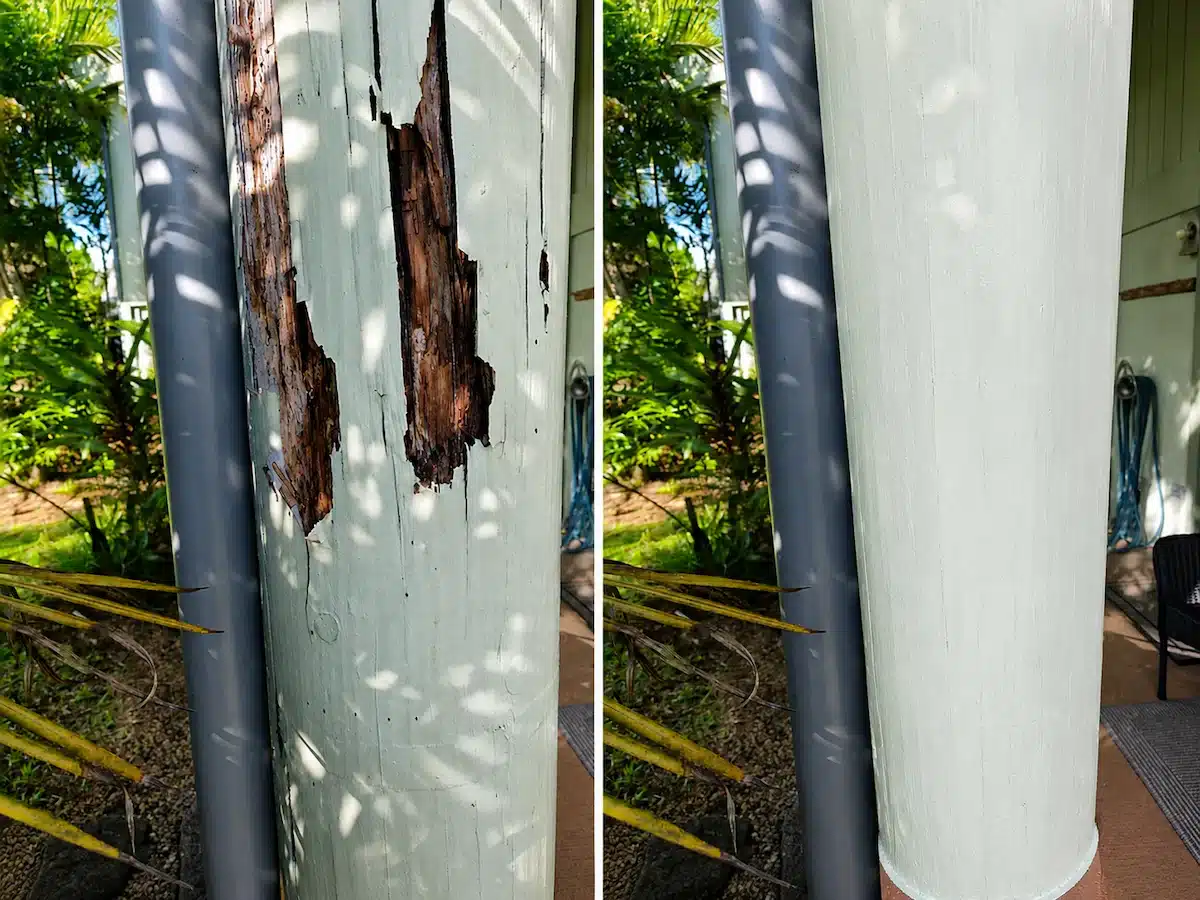
The paired image shows a visibly deteriorated painted column surface alongside a smooth painted column surface. Appearance alone does not establish the work performed, materials used, hidden condition, or load-bearing suitability.
Before
Visible base deterioration identifies where inspection begins, not necessarily the full repair boundary.
During Planning
The support role, moisture source, interior condition, and adjoining connections must be understood before material selection.
After
The localized exterior profile is shaped and finished to transition into the surrounding painted column.
MATERIAL-SELECTION HELP
Choose Materials Only After Repair Suitability Is Established
For an approved localized repair, material quantity depends on the prepared area, depth, irregularity, and number of repair locations. Product-planning tools do not replace evaluation of a column's support role or hidden condition.
Uncertain Scope or Hidden Damage?
Send clear photos and a description to WRP for product-planning help. Structural or support questions may require an appropriate qualified professional.
Compare Kit Coverage
After suitability is established, use the current guide to compare published kit coverage and deeper or irregular areas.
Narrow the Product Plan
Use the guided questions only after the work is confirmed as a localized wood-repair project.
COMMON QUESTIONS
Rotten Porch Column Repair FAQ
Can a rotten porch column be repaired instead of replaced?
A localized exterior area may be a repair candidate when the moisture source can be corrected, suitable wood remains, and the support role and hidden condition have been appropriately evaluated. Widespread, internal, moving, or uncertain load-bearing conditions call for broader evaluation.
How do I know whether the column is load-bearing?
Do not assume a porch column is decorative based on appearance alone. If its support role is not documented or obvious, consult a qualified contractor, engineer, or other appropriate professional before removing wood or relying on a localized repair plan.
What should I inspect beyond the visible base?
Inspect accessible portions of the shaft, trim, interior or hollow core, base and upper connections, nearby beam, and adjoining porch framing. An inaccessible interior remains an uncertainty rather than proof that the damage is superficial.
Which WRP products may be considered for a localized repair?
After the repair is determined to be appropriate, WRP Wood Consolidant may be part of preparation for suitable remaining wood and WRP Epoxy Dough may rebuild a localized missing profile. Topping or texture products are optional finishing choices where applicable. Follow current product instructions.
How should I choose a kit size?
Use the current Choosing Kit guide or Repair Wizard after the repair boundary and suitability are established. Deeper, irregular, or multiple areas can use more material than surface area alone suggests.
When should I contact WRP or seek qualified evaluation?
Contact WRP for product-planning help when the localized scope is unclear. Seek an appropriate qualified evaluation when load-bearing function, movement, internal deterioration, temporary support, connections, or adjoining framing are uncertain.