
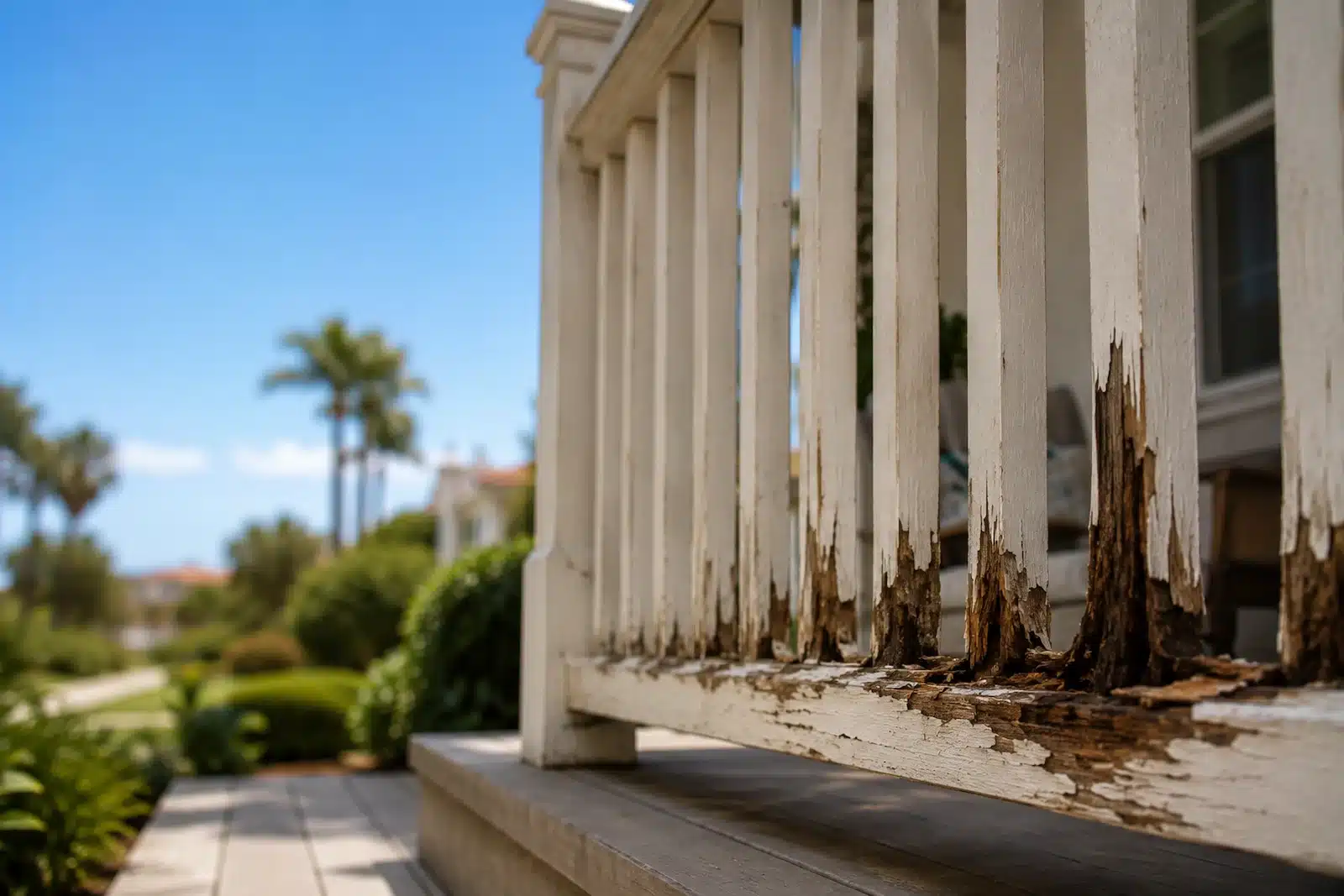
WOOD RAILING REPAIR GUIDE
How to Repair Rotted Wood Railings
A localized cosmetic or profile repair may be practical after the full railing is inspected. Movement, post deterioration, failed connections, or uncertainty about guard, stair, or fall-protection performance requires evaluation beyond choosing a repair material.
THE SHORT ANSWER
Repair Localized Damage Only After the Full Railing Is Checked
Small areas of deterioration in a rail, baluster, or noncritical profile may be repair candidates when suitable wood remains and the damage is separate from unresolved movement, post, connection, adjoining-framing, or fall-protection concerns.
Localized Noncritical Damage
A limited surface, edge, corner, or profile defect may be considered after the surrounding member and full assembly are inspected.
Suitable Wood Still Remains
Loose, brittle, crumbling, and detached material must be exposed and removed so the remaining wood and connections can be evaluated.
Safety Questions Come First
Do not use appearance or material choice to decide whether a post, guard, stair railing, fastener, or connection can remain in service.
Repair materials do not establish railing safety, code compliance, or required load capacity.
IMMEDIATE SAFETY GATE
Pause When Movement, Connections, or Fall Protection Are Uncertain
A railing may be part of a guard, stair, or elevated walking surface. Cosmetic improvement is not evidence that the complete assembly is suitable for continued use.
Post Deterioration or Movement
Pause when a post rocks, twists, pulls away, has deterioration at its base, or cannot be evaluated confidently.
Failed or Uncertain Connections
Loose fasteners, damaged brackets, split connection points, or deteriorated wood around hardware require evaluation beyond filling the visible defect.
Guard, Stair, or Fall-Protection Role
When the assembly protects an elevated edge or stair, use appropriate qualified evaluation before relying on a localized repair.
Separate safety decisions from product planning
Use qualified evaluation for safety, structural, code, and required-load questions. WRP can help with product planning only after the repair scope and suitability are established.
INSPECT THE FULL ASSEMBLY
Check Posts, Rails, Balusters, Fasteners, and Connections
The visible soft spot may not show the full condition. Inspect each member, every connection, nearby deck or porch surfaces, and the places where water can remain trapped.
Posts and Post Bases
Look for softness, splitting, movement, failed coatings, trapped moisture, and deterioration where posts meet decking, framing, masonry, or hardware.
Rails and Balusters
Inspect top and bottom rails, baluster ends, joints, spacing, and transitions for separate or overlapping deterioration.
Fasteners and Connections
Check the wood surrounding screws, bolts, brackets, and embedded hardware. Do not conceal loose or deteriorated connection points.
If damage continues into nearby deck boards, porch columns, or adjoining beams and framing, evaluate those components as part of the same scope.
REPAIR OR REPLACE
Match the Decision to the Member, Connection, and Function
A localized profile repair is different from deterioration in a post, connection, guard, stair railing, or adjoining frame. When those conditions overlap, replacement or qualified evaluation may be the appropriate next step.
Localized Repair May Be Considered When
The damage is limited, suitable wood remains, the moisture source can be corrected, and the area is separate from unresolved movement, connection, framing, and fall-protection concerns.
Replacement or Evaluation May Be Needed When
A post moves, hardware no longer holds, several members are deteriorated, adjoining framing is affected, or the assembly's continued use cannot be evaluated confidently.
Use Repair or Replace Rotten Wood? as a general decision framework—not as a substitute for railing-specific safety evaluation.
MOISTURE AND PREPARATION
Correct the Cause and Expose the Full Repair Area
Repair materials should not cover active wetting, loose fibers, failed coatings, deteriorated caulk, or uncertain connection conditions.
Correct the Moisture Source
Address drainage, sprinklers, open joints, failed coatings, trapped water, and other conditions causing repeated wetting.
Expose the Actual Boundary
Remove loose coatings and unsound material carefully so the member, joint, hardware, and surrounding wood can be inspected.
Protect Spacing and Connections
Do not alter required clearances, member alignment, drainage paths, or hardware locations while preparing the area.
Follow Current Product Instructions
Moisture condition, cleaning, application depth, temperature, cure, primer, sealant, and coating requirements vary by product.
LOCALIZED REBUILDING AND FINISH
Rebuild the Profile Without Concealing a Safety Concern
After localized repair suitability and preparation requirements are established, the material can recreate a missing edge, corner, rail profile, baluster detail, or other noncritical shape.
Recreate the Localized Shape
Use a repair material intended for the location and depth. Do not use the rebuilt surface as evidence of connection or load capacity.
Maintain Alignment and Clearances
Preserve the member's original profile, joint relationship, spacing, drainage, and access to required hardware.
Finish as Directed
After the selected material reaches its required cure condition, shape the surface and use compatible primer, sealant, and exterior coating as applicable.
Use these tools only after the damage has been established as an appropriate localized repair. For material-specific context, see the Epoxy Wood Repair Dough Guide.
THE WRP REPAIR PROCESS
A Concise Process for a Suitable Localized Railing Repair
The sequence begins with the moisture source, full-assembly inspection, and repair-suitability decision—not with the repair material.
Assess and Correct
Identify repeated wetting, inspect the complete railing and adjoining components, and resolve safety uncertainty before material planning.
Remove and Prepare
Remove unsound material and prepare suitable remaining wood according to the selected repair system's current instructions.
Rebuild and Finish
Restore the localized profile without hiding hardware or connections, then apply compatible finishing materials as directed.
COMMON QUESTIONS
Rotted Wood Railing Repair FAQs
These answers separate localized material planning from movement, connection, fall-protection, and adjoining-framing questions.
Can a localized area of railing deterioration be repaired?
It may be a repair candidate when the moisture source can be corrected, suitable wood remains, and the damage is separate from unresolved post, connection, movement, framing, guard, stair, and fall-protection concerns.
What if a railing post is deteriorated or moves?
Pause the material decision. Post condition and movement can affect the complete assembly and require appropriate evaluation or replacement planning.
Can repair material correct a loose fastener or failed connection?
Do not assume so. Inspect the hardware, surrounding wood, bracket, joint, and adjoining member. A filled surface does not establish connection capacity.
Can repair material be applied to damp railing wood?
Do not use a categorical rule. Correct active wetting and follow the current moisture-condition and preparation requirements for every selected product.
When should adjoining deck or porch framing be inspected?
Inspect adjoining components when deterioration reaches post bases, deck boards, columns, beams, stairs, ledger areas, or other connection points.
Which WRP kit should I use?
After the area is confirmed as an appropriate localized repair, use the Repair Wizard or kit comparison guide to plan materials. Contact WRP when the scope or product choice remains uncertain.