
FASCIA BOARD REPAIR GUIDE
Repairing Rotten Fascia Boards
Fascia is the board along the roof edge, often behind the gutter. A small rotten area may be repairable if suitable wood remains and the moisture problem can be corrected. Start by checking how far the damage extends before deciding to repair or replace.
THE SHORT ANSWER
Can a Rotten Fascia Board Be Repaired?
Sometimes. A localized repair may be practical when deteriorated material can be removed, suitable wood remains around the prepared area, and the source of repeated wetting can be corrected. Widespread deterioration or damage behind the fascia may require replacement or further evaluation.
Check the connected roof edge first
If rafter tails, roof sheathing, soffit framing or gutter attachments are affected, have the condition assessed by an appropriate qualified professional. WRP can help with material planning; repair products do not establish framing or gutter-support suitability.
INSPECT AND DEFINE THE SCOPE
Inspect the Fascia and the Connected Roof Edge
Peeling paint may show where the problem starts, but it does not show the full extent of deterioration. Check the visible board and accessible areas behind it. If access is unsafe or concealed damage is suspected, get help before opening or removing parts of the assembly.
Probe the Fascia
Check the face, lower edge, end grain, joints, fastener areas, and nearby painted surfaces for soft or crumbling wood.
Check Behind and Above
Look for deterioration at rafter tails, sheathing, soffit framing, drip-edge or flashing details, and the back of the board where accessible.
Review Gutter Attachments
Identify loose or compromised attachment locations and signs that overflow or leakage has repeatedly wet the same area.
Define the Boundary
Confirm where suitable wood begins and whether the repair can remain localized without making assumptions about concealed roof-edge conditions.
ROOF-EDGE CAUSES AND MOISTURE
Correct the Moisture Source Before Repairing the Wood
Look for overflowing or leaking gutters, roof-edge or flashing problems, open joints, failed sealant and damaged coatings. Address the source of repeated wetting before rebuilding the fascia. Filling the damaged area will not repair an active leak.
Gutters and Drainage
Check for overflow, leakage, poor drainage, and repeated wetting at hangers or joints.
Roof Edge and Flashing
Review drip-edge, flashing, roofing transitions, and other details that direct water away from the fascia.
Joints and Coatings
Look for open joints, failed sealant, peeling paint, and exposed end grain that can admit moisture.
Connected Components
Inspect the soffit and eave assembly where water can travel behind the visible board.
Learn more about common causes of wood rot and the relationship between fascia, soffits and framing in the rotted eaves guide.
REPAIR OR REPLACE
Repair or Replace the Rotten Fascia Board?
Compare the amount of deterioration, the wood remaining after preparation, and the condition of the connected roof edge. A limited repair and replacement are different ways to address the damage; choose the approach that fits the inspected condition.
A Localized Repair May Be Considered When
- Damage is limited to a defined portion of the fascia.
- The moisture source can be identified and corrected.
- Suitable wood remains around the prepared area.
- Connected roof-edge components are not part of the damaged scope.
Replacement or Further Evaluation May Be Needed When
- Deterioration is widespread along the board.
- Rafter tails, sheathing, soffit framing, or adjoining framing are affected.
- Gutter support or roof-edge conditions are uncertain.
- Access or concealed conditions prevent a reliable scope assessment.
Review the broader repair-or-replace decision guide before choosing materials.
PREPARATION AND REPAIR PROCESS
Prepare, Rebuild and Finish a Localized Fascia Repair
Once the repair is suitable and the moisture source has been addressed, plan safe access, preparation tools, the required repair materials, and finishing products. Follow current product labels for protective equipment, surface conditions, application, curing and coating requirements.
Remove unsuitable wood
Remove loose, soft and deteriorated material while preserving suitable surrounding wood. Stop if removal reveals damage extending into connected roof-edge components.
Clean and prepare the area
Remove debris, dust, loose coatings and contamination. Check that the remaining surface and conditions meet the instructions for the materials selected.
Use Consolidant where appropriate
WRP Wood Consolidant may be used during preparation when appropriate for the remaining wood. Follow the current label and product instructions.
Rebuild the missing profile
Use WRP Epoxy Dough for a suitable localized missing section. Recreate the fascia profile according to the product instructions and the planned repair.
Shape and finish
Follow the selected products’ instructions for shaping and finishing. WRP Topping is an optional finishing material for minor surface imperfections; it is not a substitute for rebuilding missing wood. Use compatible primer and coating products.
Review the preparation guide, Wood Consolidant guide, Epoxy Dough guide, optional WRP Topping, and current Technical Documents before use.
AUTHENTIC BEFORE AND AFTER
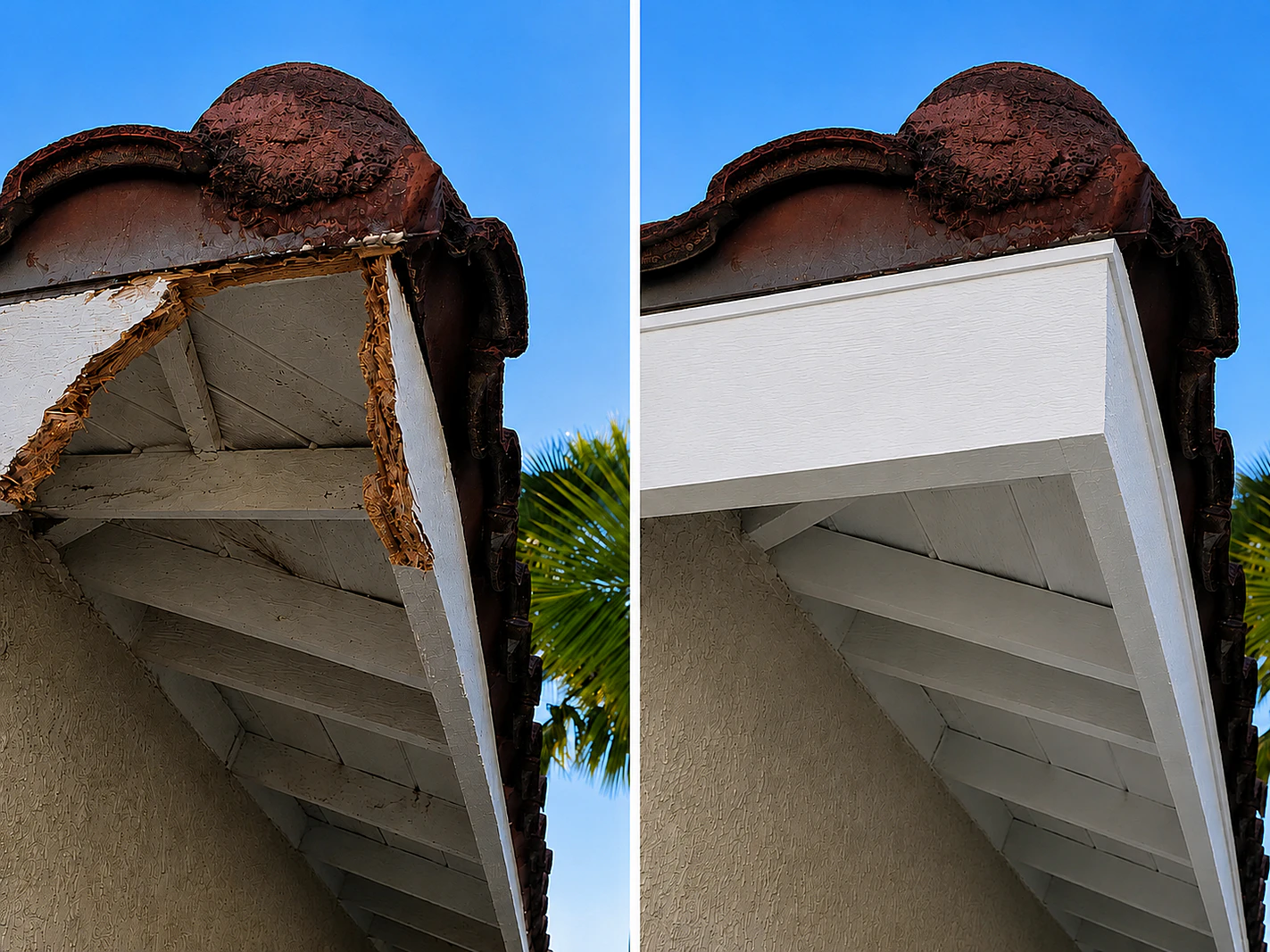
WRP Fascia Repair Before and After
WRP identifies this photograph as a fascia repair example. The two views show the damaged area and its finished appearance. Use it as a visual example, not as evidence of the concealed condition or repair suitability of another roof edge.
See additional documented examples in the WRP Before & After Gallery.
MATERIAL-SELECTION HELP
Choose Repair Materials After Inspection
Estimate materials from the prepared repair area, including its depth and irregular shape. Surface area alone may not describe how much material is needed. Compare published kit coverage and use the Repair Wizard once the repair scope is understood.
Compare the current repair-kit coverage guide after the scope is known.
Need product-planning help?
Unsure what materials to plan? Contact WRP with photos and a description of the area. Questions about roofing, framing, gutter support or safe access should go to the appropriate qualified professional.
COMMON QUESTIONS
Rotten Fascia Board Repair FAQ
Use these answers to keep inspection, moisture correction, repair suitability and material planning in the right order.
Can I repair fascia without replacing the whole board?
A limited repair may be possible after inspection and preparation confirm suitable surrounding wood. The visible size of the damaged patch alone is not enough to make that decision.
Do I need to check behind the gutter?
Gutter attachments and accessible surfaces behind the fascia can be part of the affected area. If inspecting them requires unsafe access or gutter removal, get appropriate help.
What if the rot continues into a rafter tail or soffit framing?
Stop treating the job as an isolated fascia patch. Have the connected damage assessed before selecting a repair method or materials.
Can I rebuild the wood before correcting the leak?
Correct active water entry or repeated wetting first. A wood repair does not fix a leaking gutter, roof-edge defect or flashing problem.
Are finishing products included in every repair kit?
Check the current contents of the kit selected. Do not assume Topping or other finishing products are included, and do not assume every repair needs them.
How do I estimate material quantity?
Estimate after the deteriorated material has been removed and the repair boundary is understood. Consider depth, irregular areas and multiple repair locations when comparing published coverage.