
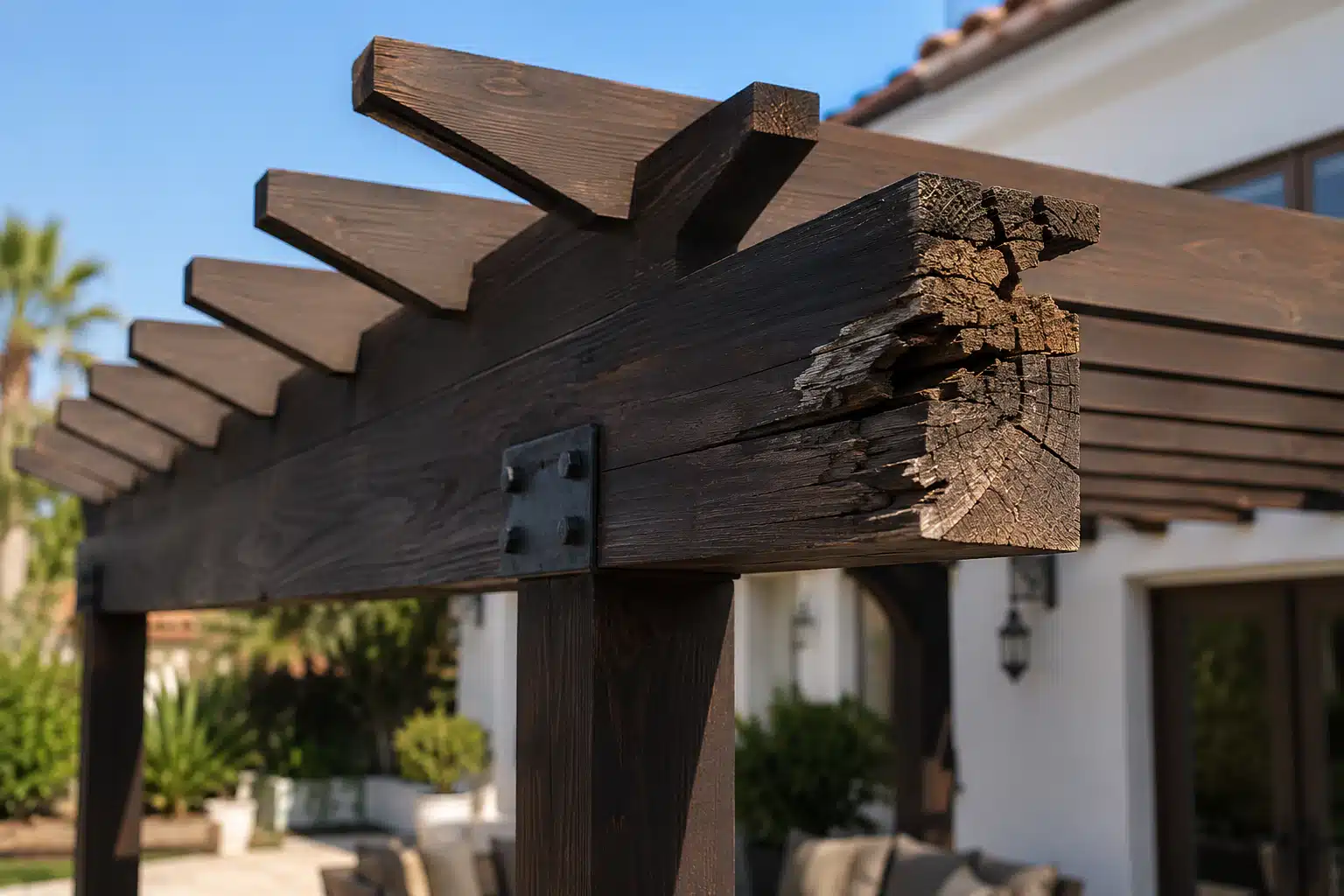
PERGOLA BEAM REPAIR GUIDE
How to Repair Pergola Beams
How to repair pergola beams depends on whether the decay is localized and whether the remaining beam, posts, fasteners, and connections can still carry their required loads. Correct the moisture source, assess the full assembly, and support the structure before removing material from any load-bearing member.
THE SHORT ANSWER
When Pergola Beams Can Be Repaired
When learning how to repair pergola beams, begin by identifying why exposed ends, deep checks, failed joints, or trapped water caused the deterioration. Repair may be practical when the damage is localized, the remaining beam and connections are demonstrably adequate, the moisture source can be corrected, and the repair design is appropriate for the loads involved.
The Damage Is Localized
A damaged beam end or isolated cavity may be rebuilt without replacing the entire member.
Firm Wood Still Remains
Stable surrounding wood must remain after loose, brittle, and crumbling material is removed.
The Beam Can Be Evaluated Safely
Connections, posts, fasteners, and the remaining beam section must still provide reliable support.
Start with How to Tell if Wood Is Rotten and What Causes Wood Rot?
INSPECT BEFORE REPAIRING
How to Inspect Pergola Beams Before Repair
Before deciding how to repair pergola beams, remember that visible decay may not show the full extent of the problem. Inspect the entire beam, nearby rafters, post connections, brackets, fasteners, and any areas where water can collect.
Probe the Wood Gently
Check whether the wood is firm or soft without forcing a tool through healthy material.
Inspect the Beam End
Look for deep checks, open end grain, peeling finish, dark staining, and missing fibers.
Check Connections
Confirm that bolts, brackets, screws, and post connections remain secure and free of movement.
Review How Much Rotten Wood Should Be Removed? before cutting, scraping, or drilling.
MAKE THE RIGHT DECISION
When to Repair or Replace Pergola Beams
Repair is best for localized deterioration. Replacement is generally more appropriate when decay affects a large portion of the beam, connections have failed, or the member no longer carries loads safely.
Repair May Be Practical When
The damaged area is limited, firm wood surrounds the cavity, and the original profile can be rebuilt while maintaining support.
Replacement May Be Better When
Rot extends deeply through the beam, the member sags or twists, fasteners no longer hold, or adjacent components are damaged.
Compare the options in Repair or Replace Rotten Wood?
PREPARATION MATTERS
How to Prepare Pergola Beams Before Repair
A durable approach to how to repair pergola beams requires clean, dry, stable wood. Do not place repair material over loose fibers, trapped moisture, failed coatings, dirt, or deteriorated caulk.
Stop the Moisture
Correct failed flashing, exposed end grain, irrigation spray, roof runoff, and horizontal surfaces that hold water.Remove Unsound Wood
Remove soft, brittle, crumbling, and detached material while preserving firm wood.Clean and Treat
Follow the complete wood preparation process before rebuilding.REBUILD THE DAMAGE
How to Repair Pergola Beams with WRP Epoxy Wood Repair Dough
The next step in how to repair pergola beams is to recreate the beam end, edge, corner, and original dimensions while maintaining clearance around nearby rafters, brackets, and decorative details.
Strengthen Remaining Wood
Apply WRP Wood Consolidant to prepared, clean, dry wood according to product instructions. When rebuilding with WRP Epoxy Dough, apply the mixed dough within the approved application window, without waiting for the consolidant to fully cure.
Use Cobra Rods Where Appropriate
Cobra Rods are wood preservative rods and do not provide structural reinforcement. Conditions involving beam support, connections, framing, or concealed deterioration require qualified evaluation before repair materials are selected. Review how Cobra Rods fit into the WRP process.
Rebuild Missing Areas
Use WRP epoxy repair dough to recreate missing corners, edges, and profiles. See the epoxy repair dough guide.
STRUCTURAL SAFETY
How to Confirm Structural Safety Before Repairing Pergola Beams
A repaired surface is not enough if the beam, posts, fasteners, or connections have lost structural integrity. Evaluate the full load path before relying on the finished repair. Shore or support the pergola as needed before removing wood, and obtain qualified structural guidance when the beam carries significant loads, a connection is compromised, or remaining capacity cannot be confirmed. Exposed beam tops and joints should shed water rather than trap it; see the American Wood Council guidance on flashing and shielding exposed wood.
Check for Sagging or Twisting
A beam that has changed shape may indicate deeper structural damage or overloaded connections.
Inspect Posts and Brackets
Confirm that posts remain plumb and that bolts, screws, and metal brackets still hold securely.
Use Professional Evaluation When Needed
Consult a qualified contractor or engineer when the beam carries significant loads or structural integrity is uncertain.
For similar large-member repairs, review Repairing Structural Beam Ends.
THE WRP REPAIR PROCESS
How to Repair Pergola Beams in Three Stages
Prepare and strengthen suitable remaining wood, rebuild the missing beam section, and protect the finished repair from future moisture.
Prepare and Strengthen
Correct moisture problems, remove unsound wood, clean the cavity, and consolidate suitable fibers.Reinforce and Rebuild
Add appropriate reinforcement when required and restore the missing beam end, corner, or edge.Finish and Protect
Refine the surface, verify stability, then prime, paint or stain, seal exposed end grain, and maintain the area.COMMON QUESTIONS
Frequently Asked Questions About How to Repair Pergola Beams
These answers cover common pergola-beam repair questions. Every repair should still be evaluated based on beam size, damage depth, connections, and loading.
Can a rotted pergola beam be repaired without replacing the entire beam?
Sometimes. Localized damage may be repaired when enough firm wood remains and the beam and its connections are structurally reliable.
Why do pergola beam ends rot?
Exposed end grain absorbs water quickly. Failed coatings, deep checks, irrigation spray, and poor drainage can keep it wet long enough for decay.
Does all soft wood need to be removed?
Loose, brittle, crumbling, and detached material should be removed. Preserve firm wood that can support the repair.
Can epoxy repair material be applied to damp pergola wood?
No. Correct the moisture source and allow the prepared area to dry enough for proper penetration, bonding, and curing.
When are Cobra Rods used in a pergola beam repair?
Cobra Rods are wood preservative rods, not structural reinforcement. Pergola beam conditions involving support, connections, significant deterioration, or concealed damage require qualified evaluation before removal or rebuilding.
Can the repaired beam be sanded, stained, or painted?
Yes. After curing, the repair can be shaped and sanded before compatible exterior primer, paint, stain, and sealant are applied.
Which WRP kit should I use for a pergola beam?
Kit size depends on repair volume. Review Choosing the Right WRP Repair Kit or contact WRP.
CONTINUE PLANNING YOUR REPAIR
Plan How to Repair Pergola Beams With Confidence
Continue with guides covering structural beam ends, wood preparation, and repair-kit selection.
Repairing Structural Beam Ends
Review repair principles for localized decay in large structural wood members.
How to Prepare Wood for Repair
Learn how to clean, dry, and stabilize damaged wood before applying repair materials.
Choosing the Right WRP Repair Kit
Compare kit sizes based on repair depth, number, and total volume.